Foundations – a force we must put to use now

Illustration
Exclusion. Mental ill health. Climate crisis. Rising inequality. We live in a time defined by complex challenges – challenges that demand more than one solution, more than one actor, and more than one approach. In the face of all this, there is a resource that remains underutilised: foundations.
In Norway, there are more than 6,300 foundations. Together, they manage substantial assets and distribute more than NOK 7 billion each year. Yet their role in shaping society is often overlooked – and far too rarely leveraged strategically.
That needs to change. Because foundations can be a vital part of the solution.
What role can foundations play?
At the Norwegian Foundations Association’s seminar in March 2025, Kavli Trust’s Chief Executive Officer, Ingrid Paasche, delivered a speech with a clear message: foundations have both the opportunity and the responsibility to help address the greatest societal challenges of our time.
Not as a substitute for the public sector, but as catalysts for what works. As drivers of knowledge, innovation and long-term solutions.
She highlighted three key priorities:
1. Creating room for innovation
Foundations have the freedom to take risks. That gives us the ability to support untested ideas – and to act quickly. Where the public sector is bound by lengthy processes and businesses require financial returns, we can test, learn and build from the ground up.
A strong example is the Norwegian Food Banks (Matsentralene), which now rescue more than 4,000 tonnes of food each year and distribute eight million meals to people in vulnerable situations across Norway. This work began on a small scale and became possible because foundations were willing to invest time, funding and trust over many years.
2. Documenting and sharing what works
Knowledge is crucial when resources are scarce. We must demonstrate what creates impact – and what does not. Since 2017, Kavli Trust, through its Health Research Programme, has awarded a total of NOK 172 million to research on children’s and young people’s mental health. The programme is designed to avoid research waste, ensure efficient use of resources and maintain transparency throughout the process. The aim is to ensure that research genuinely benefits those who need it, and to prevent findings from being left in a drawer, regardless of the outcome.
Research must be accessible, applicable and effectively communicated.
3. Collaborating and scaling
The biggest challenges cannot be solved alone. We must build partnerships – with municipalities, academic communities, voluntary organisations and other foundations. Collaboration enables scaling, allowing successful initiatives to contribute to systemic change.
Initiatives such as Speed School in West Africa, which has helped thousands of children return to school through collaboration between civil society organisations, foundations and international partners, demonstrate what is possible. When something works, it must be scaled.
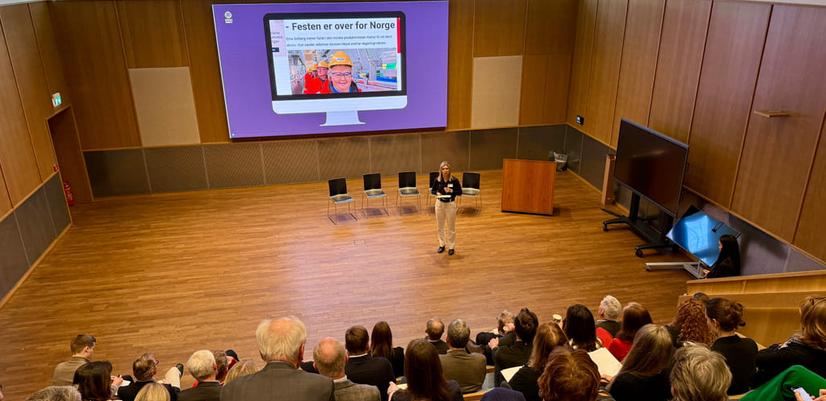
Clear message
Kavli Trust
A society in transition – and in need of a steady course
In a world of growing geopolitical tension, and where major actors such as USAID are withdrawing from important development and research efforts, the role of foundations becomes even more important.
We can be the stable link.
The long-term supporter. The courageous risk-taker. The values-driven actor – concerned not only with funding, but with direction.
Foundations can support those left behind when major powers withdraw. They can fill funding gaps when others step away. They can ensure that vital knowledge, research and innovation continue – and create value for more people.
What is this really about?
It is about building a society in which more people have the opportunity to participate, contribute and succeed – regardless of their starting point. It is about generating, sharing and applying knowledge to create solutions that create positive ripple effects and endure over time.
It is about collaboration, about daring to take risks and about long-term commitment.
It is about being present. Now.
For Kavli Trust, this is at the very core of our work: contributing to solutions to the greatest societal challenges of our time – with our values as our compass and the common good as our goal.