Bringing the 4-Day Treatment to the U.S. – Travel Report from Los Angeles
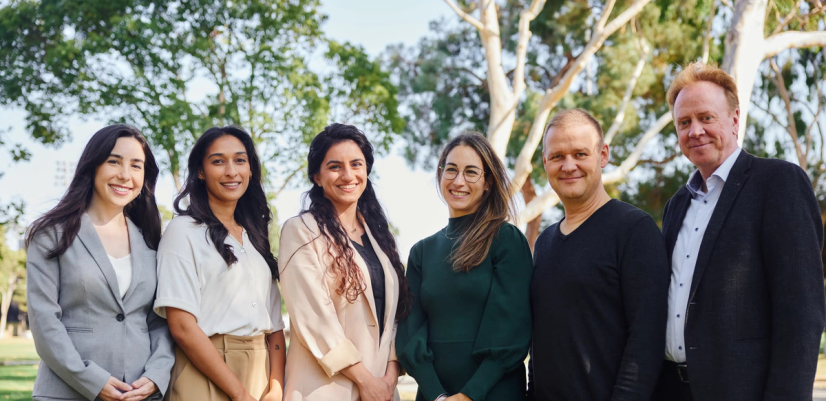
Last week, Bjarne Hansen was in Los Angeles to train healthcare teams and treat patients using the 4-Day Treatment. Some had traveled halfway across the globe to receive help.
From the airport, he writes about the work being done in the U.S., and the professional journey that brought him there. He also shares professional reflections and thoughts on how both patients, therapists, and institutions can risk getting caught in unhelpful patterns.
With support from Kavli Trust, patients around the world are gaining access to the Bergen 4-Day Treatment for anxiety and obsessive-compulsive disorder (OCD). Project leader and psychology professor at Haukeland University Hospital, Bjarne Hansen, regularly writes for Kavli Trust about the international work to spread the treatment.
Text: Bjarne Hansen
Professor and Project Leader
Bergen Center for Brain Plasticity and the OCD Clinic at Haukeland University Hospital
At the end of my psychology studies, everything came to a halt.
I was about to begin my clinical internship and had been placed at a unit where my main task would be to talk to people who had recently attempted to end their lives.
There was no framework for follow-up beyond a couple of conversations for clarification and support. I felt completely unprepared — like standing at the edge of a cliff without seeing the bottom, or walking toward a wall I couldn’t get around or over.
A wave of panic
What I had long pushed away hit me like a wave of panic just before the internship started. Desperate to get out of the situation, I found my way to the office of department head Tore Stiles.
He didn’t ask difficult questions or try to change my mind — something I was grateful for. Instead, he asked if I would be interested in an internship focused on learning cognitive therapy. One phone call and a few minutes later, Tore had found a solution and offered to be my clinical supervisor. A few days later, I was on my way.
That was the start of a career journey that, 23 years later, has brought me to an airport in Los Angeles.
This past week, I’ve been here with my amazing colleague Thröstur Björgvinsson to supervise a group of American psychologists. I also led a 4-Day Treatment group.
Together, we’ve gotten to know five courageous individuals whose lives have long been overshadowed by anxiety and compulsions. While their effort far exceeds ours, it has been meaningful to help — and in just a few days, we’ve witnessed significant changes.
Early Foundations
Toward the end of my internship, Tore Stiles once again helped me by connecting me with Professor K. Gunnar Götestam, who offered me a PhD position.
The project had one broad goal: to develop better treatment for people suffering from OCD.
I had an office next to Sidsel Myhr and the Norwegian OCD and Anxiety Association, Ananke. This led to friendships and collaborations that have been central throughout the years.
Inspired by studies from England, I wanted to explore how different understandings of mental illness and change could significantly influence the outcomes of exposure therapy.
One result of this work has since been referred to as LET – a framework of theory and procedures to recognize and break out of harmful patterns where attempts to reduce uncertainty actually reinforce the problems.
Even during psychological treatment, there's a risk that desired change won’t happen despite great effort. The solution is rarely to push harder and add more tasks. Instead, we must offer tailored support to help people identify harmful patterns and release the need for control they’ve desperately tried to maintain.

Reflection
Bjarne Hansen
Effective methods, but limited access
Developing new strategies has been both exciting and rewarding. At the same time, it was painful to see that those seeking help had little access to methods that had been shown effective — some since the 1960s.
It would be too simplistic to blame this solely on a lack of prioritization. Norway has long been among the world leaders in public funding for mental health. Despite this, we have struggled to ensure that people affected by obsessive-compulsive disorder (OCD) have access to evidence-based treatments.
Hardly a day went by without discussing this with Sidsel and others at Ananke. Many initiatives, courses, and campaigns were launched — with little effect. We kept increasing our efforts but saw no results, because we were essentially repeating the same mistakes.
Over time, it became clear that the biggest challenges lay in how care was organized. The generalist model expected every therapist to be able to handle any issue.
A review showed that most therapists had minimal training and very little experience with this type of treatment.
Few would accept a hip surgery performed by someone with just a few hours of theoretical training and little or no practical experience.
National reform and rapid development
This led to a professional and political push to change how OCD care was organized. With help from Ananke, media, and national politicians, a decision was made to establish specialized OCD teams in every regional health trust. I was tasked with leading this national effort.
Together with the Norwegian Association for Cognitive Therapy (NFKT), Ananke, and skilled colleagues, we reached the goals we had set.

Avkobling
Bjarne Hansen
We also received invaluable support from Professors Jonathan Abramowitz, Marty Franklin, and Joseph Himle — some of the most respected international experts in the field.
Within four years, we trained and established 30 OCD teams, covering all regional health trusts in Norway.
There is always room for improvement, but we’ve come light-years closer to providing effective help.
The reorganization also paved the way for rapid development and internationally recognized research. While treatment costs per case have decreased, we are achieving more.
As individuals, we risk getting stuck in patterns where we desperately increase our efforts in the hope of making progress.
From Switzerland to Los Angeles for treatment
During the past week, I have once again seen how destructive this can be. Remarkable people experience losing themselves in the struggle to achieve the opposite.
One day, we held a meeting with their relatives. They too described a struggle where the efforts to help have led them further into a fog of despair and discouragement.
One of the parent couples had traveled all the way from Switzerland to attend this meeting in Los Angeles. They would have traveled to the ends of the earth and back, every day if necessary, to help their child. I will never forget the mixture of despair and optimism in the people I had just met for the first time.
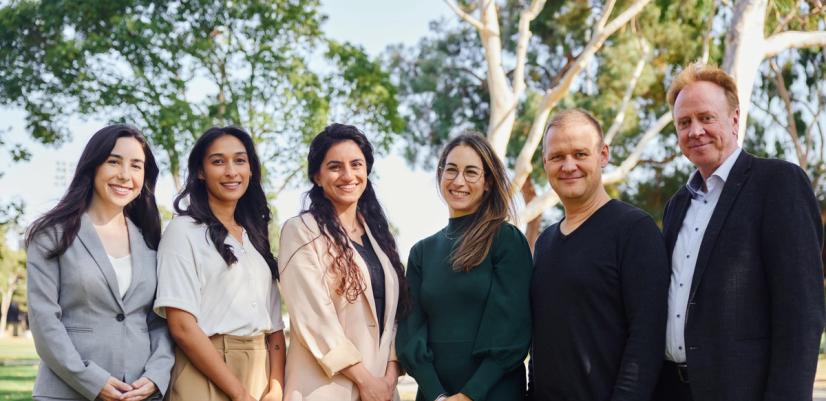
The team in Los Angeles
The OCD Team / Helse Bergen
An exciting continuation ahead
The memories from Los Angeles are still finding their place — but they’re already leaving a lasting mark.
There’s something striking about work where the same types of patterns appear in patients, therapists, and even institutions.
We as healthcare systems and providers also risk falling into loops — trying harder, doing more — without changing the underlying pattern. We risk repeating the same mistakes with increasing effort. Often, the solution is not to do more, but to do something different — with more purpose.
The LA therapists are not just adopting the method for themselves. They will also train therapists from other countries.
Thanks to support from Kavli Trust and growing interest in the field, we are on track to meet our ambitious goals.
After a rewarding week with super-colleague Thröstur Björgvinsson and the team in LA, I’m excited for what’s next!
Note: This article is written entirely by an external contributor. The opinions expressed are those of the author.
Facts – NOK 35 million for international implementation
- In 2018, Kavli Trust awarded NOK 35 million for the international implementation of the 4-Day Treatment (B4DT)
- The project is led by Bjarne Hansen from the Bergen Center for Brain Plasticity at Haukeland University Hospital.
- The center is a collaboration between Trond Mohn Foundation, the University of Bergen, Haukeland University Hospital, and Kavli Trust.
- Trond Mohn Foundation also supports development of new adaptations of B4DT for patients who do not respond to the current version.
- Kavli Trust has previously supported national implementation in underserved regions in Norway as part of its mental health focus for children and youth.
- Hansen and his team train and supervise healthcare teams as they treat real patients — combining training with intervention and research.
- The data is used to understand how the treatment works, who it doesn’t work for, and why.
- This makes the implementation process part of ongoing development of new treatment approaches.
- The international project is the largest single research initiative Kavli Trust has ever supported.
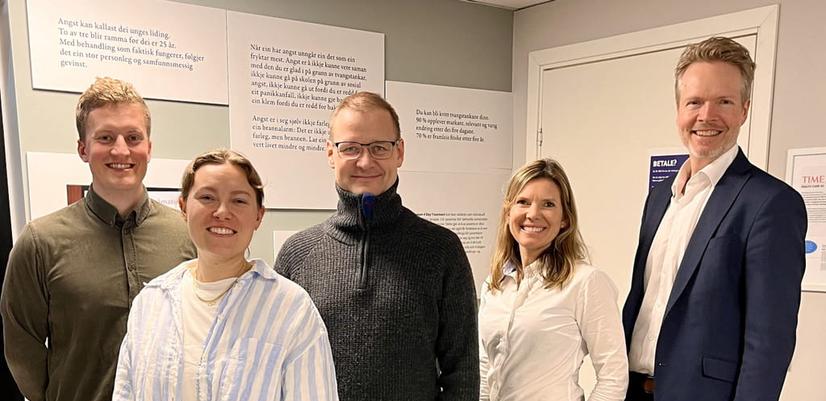
Visiting the OCD Team
Hanne Eide Andersen/Kavli Trust