Treated Anxiety and Obsessive-Compulsive Disorder (OCD) in Four Countries

“We have accomplished much more than we planned before the pandemic stopped everything,” says clinical psychologist Bjarne Hansen. In 2022, he and the rest of the Norwegian team ensured that new healthcare teams in Singapore, Germany, Sweden, and Finland received training in the 4-day treatment for anxiety and obsessive-compulsive disorders (OCD).
March 2020: Everything was set and ready. Flight tickets, hotel bookings, and a packed schedule for the entire week were in place. Bjarne Hansen and Gerd Kvale, the two clinical psychologists who developed the 4-day treatment for anxiety and obsessive-compulsive disorders (OCD), were excited to travel to Singapore.
They had already visited once for an introductory meeting and had been introduced to some of the country’s leading mental health professionals. Now the real work was about to begin. Together with colleague and clinical psychologist Krister Hagen, they were to train Singapore’s healthcare teams in the treatment and provide therapy to the very first patients.
Then the message came
The day before their departure, the hospital in Singapore informed them that the risk level had been raised to orange, and meetings could be limited to only two people per session. The cause was COVID-19.
“Everything came to a halt because of the pandemic,” says Bjarne Hansen.
Since 2017, Kavli Trust has funded efforts to make the treatment—officially called The Bergen 4-Day Treatment (B4DT)—available to as many people as possible.
“Kavli Trust continuously strives to ensure that our funding has the greatest possible impact. B4DT contributes not only to positive change in individuals’ lives but also generates cost savings for society. We are proud to support this work as part of our commitment to improving mental health among children and youth,” says Inger Elise Iversen, CEO of Kavli Trust.
“Because the training of healthcare teams also involves direct patient treatment, we find that the funds from Kavli Trust are used very effectively. This approach fits perfectly with our grantmaking principles,” Iversen adds.
Impressive international results
After two years of pandemic restrictions, the world reopened in 2022, allowing Bjarne Hansen and his colleagues to resume their training efforts. During the year, they trained healthcare teams in Sweden, Finland, Germany, and Singapore.
“What a journey it has been. We have adapted the training to fit each country’s healthcare system, language, and culture,” Hansen explains.
Surprisingly, the differences between Norway and Finland were greater than between Norway and Singapore.
“Not many, myself included, expected that,” he says, describing it as a fantastic experience to work with so many different colleagues on their home turf. Everywhere, the Norwegian team encountered enthusiasm and goodwill, achieving strong results both in training and patient treatment.
“We have met many skilled colleagues—motivated, capable people who are open to new approaches and willing to be challenged,” he adds.
Faster dissemination and major steps forward
“The training we provide is also designed to empower these teams to train new teams independently. This is a positive development that increases the sustainability of our work. Dissemination is faster and more cost-effective,” says Hansen.
The next major step will be to start training efforts in low- and middle-income countries.
“We are considering several countries in both South America and Asia. I think this will be fantastic and very exciting,” he reveals enthusiastically.
Became a psychologist after working with patients
Becoming a psychologist was not a given for Hansen. After completing introductory courses in political science and history of ideas, he received an excellent grade halfway through his psychology studies at the University of Oslo.
That opened the door to a professional psychology program at NTNU in Trondheim.
“There were very few spots available. I mostly thought, ‘I just can’t say no,’” he says today.
Still, he was uncertain for a long time about whether psychology was the right path for him—until he began working directly with patients.
“Here, I got to work closely with other people toward a common goal. It was very rewarding to set goals, make a solid plan, and then create change together with the patient. From the very beginning, I felt this was a field where I could make a difference, and that it suited me very well,” he explains.
Around the world with Kavli support
Little did the young man from southern Norway know that his career choice would one day take him halfway around the world with a treatment for OCD. Nor did he expect that this journey would be funded by values created by Kavli’s cheese factory in Bergen, the city that later became his workplace.
“Kavli’s founder, Olav Kavli, was an adventurer and pioneer who traveled to 60 countries carrying cheese in his suitcase. This is how he ensured great success for the Kavli Group both domestically and internationally,” points out Inger Elise Iversen.
“It’s amazing to think that Olav Kavli’s journey around the world with his cheese suitcase 100 years ago is now helping make it possible for Bjarne Hansen and his team to travel the world with an innovative OCD treatment ‘in their luggage.’”
Read more: You can read this interview and other stories from the projects we support in Kavli Trust’s 2022 Annual Report!
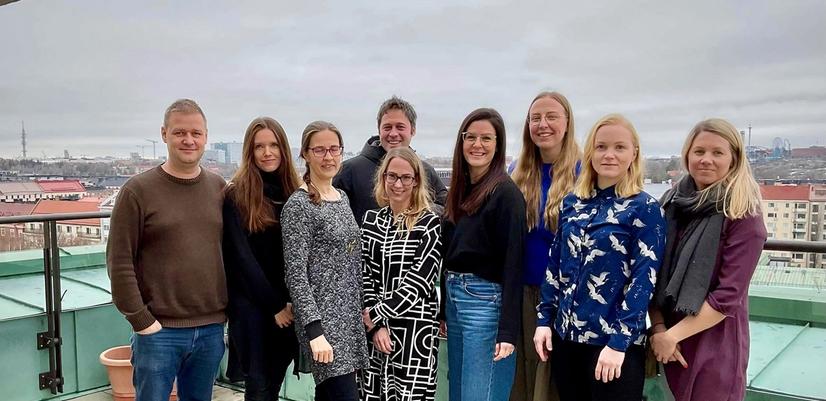
Training in Finland
Private
Never tired of patients
On his journeys, Hansen also carries a genuine desire to work together with both dedicated colleagues and patients to create positive change.
The fact that training new healthcare teams involves active participation in patient treatment suits him perfectly.
“I never get tired of meeting patients,” he declares.
He is naturally motivated by seeing the contrast between all the qualities in the people he meets as OCD patients and the way the disorder affects their lives and functioning.
Taking back their lives
“It’s so senseless. If you’re missing a foot, you can’t run. That’s a limitation we can’t do anything about. But with OCD, most people can learn simple techniques that work within a few days, and thus take back their lives completely. They just need to get the treatment.”
He is passionate about conveying that there is hope and possibilities for change, even for those hardest hit and locked into patterns of anxiety, depression, or other mental illnesses.
“For some, small or large steps in the right direction are possible. For many, it’s within reach to become completely healthy,” he concludes.

Nordic Conference
Kristen Hagen
What is the Bergen 4-Day Treatment (B4DT)?
- B4DT, or the 4-day treatment for anxiety and obsessive-compulsive disorder (OCD), was developed by Bjarne Hansen and Gerd Kvale, both professors and clinical psychologists at the University of Bergen and Haukeland University Hospital.
- The treatment is based on cognitive behavioral therapy (CBT) and consists of four days of individually tailored, intensive exposure therapy delivered in a group format, with one therapist per patient.
- Patients maintain regular contact with their therapist even after completing the treatment.
- Multiple studies have shown that approximately 90% of patients experience significant improvement after four days, and 70% remain symptom-free four years post-treatment.
- These results have been confirmed in a randomized controlled trial (Launes et al., 2019b).
- Hansen and Kvale have also developed effective training modules to rapidly and cost-effectively disseminate the treatment internationally.
- Healthcare institutions worldwide have expressed strong interest in the treatment.
- In 2018, Kvale and Hansen were named by Time Magazine among the 50 most influential people in health globally for their work with B4DT.
35 million NOK for International Dissemination
- In 2018, Kavli Trust awarded 35 million Norwegian kroner to support the international dissemination of B4DT.
- This multi-year initiative is currently led by Bjarne Hansen and based at the Bergen Center for Brain Plasticity at Haukeland University Hospital.
- The center was established through collaboration between the Trond Mohn Foundation, the University of Bergen, Haukeland University Hospital, and Kavli Trust.
- The Trond Mohn Foundation funds further development of B4DT to adapt the treatment for patients who currently do not benefit from it.
- Kavli Trust has previously supported the spread of B4DT within underserved regions of Norway, as part of the foundation’s commitment to improving mental health among children and adolescents.
- Bjarne Hansen and his team train healthcare professionals and subsequently provide ongoing guidance in patient treatment. This approach integrates training with practical application and enables data collection for research purposes.
- Collected data serve as a research foundation to better understand how the treatment works, for whom it is less effective, and why.
- Thus, the dissemination effort itself contributes to the ongoing development of new treatment variants aimed at helping those who do not sufficiently benefit from the standard 4-day treatment.
- This international dissemination project is the largest single research initiative ever supported by the Kavli Trust.
OCD – A Disorder of the Young
- OCD stands for Obsessive-Compulsive Disorder.
- Although exact figures are unavailable, it is estimated that 1–3% of Norway’s population (around 100,000–150,000 individuals) suffer from OCD.
- Most people experience their first symptoms at a young age.
- Typical obsessions include fears of illness or concerns about having forgotten something important (e.g., leaving the stove on), which are believed to potentially cause dangerous consequences.
- To relieve anxiety and distress, compulsive behaviors are performed, such as excessive handwashing, checking doors, windows, and electrical appliances, extreme orderliness, a need for symmetry, or mental rituals like counting to a specific number.
- The causes of OCD are complex, involving both genetic and environmental factors.
- OCD can severely limit patients’ daily lives and is one of the leading reasons why young people drop out of education or employment and take long-term sick leave.
Source: Norwegian Health Authorities and the Norwegian OCD and Anxiety Association (Ananke.no)